Tuesday, November 29, 2011

4A. A revised post addressing how a theme or theory we discussed in this course relates to your practice.

I'm supposed to write here more about how our studies relate to our own art. Since I've already discussed the relationship to our studies the first half of the semester I'll try here to relate to our study in the second half of the semester, which has been largely on site, fieldwork, and location.

What this means is that the manner in which I present my art work and its location contribute to its aesthetic and interpretation. Currently I display my artwork in galleries and will have some in the Hallie Ford Museum during the senior art show. Because my work is not shown out-of-doors I find it difficult to address the theories about outdoor spaces affecting my work. Instead I will focus on how the indoor space of a gallery affects my work. I place both descript and non-descript art in shows, usually in the form of paintings and ceramic wall hangings.  By hanging the work on the wall I am elevating it's importance and making you look at it as an equal. The viewer has to involve themselves under controlled conditions of light and view at a distance that pulls them into a relationship with the art. This requires them to share the same space and alter it with their presence. The outside world cannot insert itself in the experience and I control what the viewer can see. The mood will be the one that I choose and is difficult to reinterpret. The viewer may choose to accept or reject the mood I have created with my art, but the only way they can change it is through their own philosophy about what is represented. If they participate in interpreting the art they will insert themselves somehow.

My work is not monumental, and I do not put my sculptures on a pedestal, but rather I hang it in front of the viewer for them to interpret as a more tangible and equal object. Because the work is not monumentalized its function is nomadic and it depicts its own reference.  It is almost homeless because you have nothing to relate it to but itself and a bare wall with lights. Because it is transportable the viewer may take the work to her own place and imagine it included there, in some sort of idealist place.
Or the viewer may exclude the art from his world and choose to limit its influence. The viewer gets to choose, in some regard, how important to make the art. If it were monumentalized and permanently installed in a location that the viewer must interact with, the viewer would have to interact and the art would be an architectural feature in their world. This is more of a cultural situation and would expand the world of the viewer.

My art would not easily qualify as relational art because of its portability. But should a viewer purchase it and take it home to install it in a semi-permanent location they would be making it relational art. In relational art the authorship and audience become more important and gain a social aspect because the audience participates with the art.

Even in the gallery a critic could spend time with my art critiquing it for relationships. In pieces like my "Tea Time" and "Coffee Time" (see below) a critic could discuss either isolation or sharing. In something like my untitled clay tiles or flowers (below) a critic might expand into meanings of society, patterns, repetition, individuality, or seductiveness. Using these expansive ideas the art takes the viewer into an expanded field of influence.

Coffee Time, 2011, Acrylic on Canvas, 9"x12"

Tea Time, 2011, Acrylic on Canvas, 9"x12"

Poppy, 2011, Ceramic, 5" diameter

Unfinished, 2011, Ceramic, 5" tiles

Monday, November 21, 2011

Elevator Talk

This assignment was to post a copy of our elevator speech/talk.  I wrote this:


Hi, I’m Bonnie Balogh. I am a contemporary ceramic artist. I like working with clay because it makes me feel like I am a part of nature. I am an idealist and choose to reflect on growth, spirit, and relationships by modeling shapes that reflect patterns, society, and the expectations of others. My current theme is a social commentary on controlling and repetitive structures in society, and the stagnation they can cause. I believe societies can cause a group-think of oppressive rules and I feel controlled by them. Patterns are visually seductive so I use them to represent society, and then I insert an element that is different to juxtapose the pattern and represent my breaking free from the rules. The viewer has to decide what is more important, the seductive pattern or the individual element. 

Photo assignment

This week our assignment was to do a random act assigned by an artist.  Mine was to cut a rose and give it to a stranger.  Here is my picture doing this.  Nice lady deserved a flower, but I found this assignment to be an unfullfilling time-waster. I hope there are no more assignments like this.  Where is the art?

Sunday, November 6, 2011

Influences Map

This weeks assignment was to create a map of our artistic influences and post it on our blog.  I didn't like doing this because it is nobody else's business why I do what I do and I don't want to put it out there for others to judge. I didn't realize how strongly I felt about this until we were reviewing our assignment in class. I unintentionally picked the crappiest piece of paper I had, and though we were asked to use pencil I didn't care that it was hard to read.  And as I heard others tell what influenced them I realized some of those things could go on my map too, but I didn't think to add them while I was fighting with myself about what was "safe" to write down. I feel pretty strongly about telling others what influences me, because I don't want to be told what to think or do.  I don't mind listening to other perspectives and choosing what works for me, but I know that naming something is giving it power and I don't want to give others power over me.

I also realize the reason I really don't like to blog and don't want to have one is because I feel so strongly that I am not safe when I divulge my innermost thoughts. For the longest time no one has cared what the heck I think anyway.  Why should I waste my time writing down things no one reads or responds to? I'd rather be making art.  That is something people respond to. Only a few people have earned my trust and are truly interested in my words.

I have had a web site for several months that I post my art images to and my husband blogs on. We get about 16 hits a day on it and in as many months neither one of us has had so much as one response or email from the site.  (Yes, we tested it by emailing ourselves.)  I feel like blogging is a big waste of time. I don't follow any blogs except for this class, and it seems like no one interacts much here either.  Hmm. If you are out there reading this and want to prove to me that I am wrong and blogging is being read, I invite you to post a comment on this site.  :)

Here is the map.  It is the best image I could get with my 10 megapix camera, a flash, and sharpening the image in Photoshop. TTFN.

Tuesday, October 4, 2011

Contemplations on my work related to the body.


            In exploring how my work relates with categories for debating the body in contemporary art I will examine: 1) performance art; 2) minimalism; 3) aesthetics; 4) post-structuralist rendering of the disciplined body; 5) abject art; 6) aesthetic enactment of the disappearing, vanishing body; and 7) the Cyborg. My work may fit into a few of these considerations because manipulating clay is very physical and tactile. I relate my creations to myself, and therefore my body, because I am depicting how I differ in form, from the shapes around me.
            I suppose I could stretch my imagination to relate clay art to performance art. A certain amount of my physical action is required to pound the clay into the correct smoothness to create with. Beating and mashing the clay repeatedly is a way to show how I generate outcomes. My presence is manifest through these actions.
            Minimalism is in my work when I use a non-representational form like a ceramic spiral to represent myself. The viewer must come up with their own consideration about what this form means.  A body without a familiar form requires contemplation and cannot be categorized.  I can manipulate negative space and cause the viewer to think about my absence as well as my presence. The spiral might mean I continue indefinitely or it may mean I am waiting to be resurrected. It could also mean I am stuck in an infinite cycle.
            Clay is always a very aesthetic presence. People want to touch it and seek out the tactile shapes in their perfection or imperfection.  I incorporate textures into my work to invite viewers to touch them. To feel clay the viewer must feel the earth and their mortality, because we all serve the earth, even as compost. To think of clay you will eventually come to realize you will return to it someday.  And so, then, in every one of my clay artworks is a tiny bit of our history, our humanity. Bringing clay to forms of artwork is bringing people back to life, in a new form, and incorporating the fragmented bodies of others. Clay is how we all embrace death and then become immortal.
            I often think of the aesthetic enactment of the disappearing, vanishing body by deconstructing rules of gender. I like to make goddess figures that remind me of female power. My spiral shapes also relate to the feminist notions of modern day goddess worshipers by embodying the spiral dance of life. I give women the same (if not greater) power as men and perpetuate female empowerment by allowing my spirals to interrupt the patterns and oppressive molds of society. I increase female power by increasing the size and displacement caused by my spiral shapes.
            I’m pretty sure I don’t use abject art models in my work. I don’t like and purposely avoid images of the body that are revolting and disgusting. The closest I can come to relating to this type of work is the occasional passing thought that an extrusion of clay resembles a turd. I quickly remedy this and move on.
            When people look at my artwork and don’t understand or care to contemplate it they are treating it like the enactment of the vanishing body.  It is painful to be invisible, so I craft my pieces to have as much impact as possible. Yet there will always be those who don’t give a damn about it. I suppose if I wanted to embrace the concept and enact the vanishing body I could leave clay in an untouched heap so it would be as unimportant as the dirt that it is. I’m sure many people would walk by and not even contemplate the value of a lump of earth, or distain my work as meaningless.  If they only thought about it, that earth is the body, immortalized.
            Last, in considering the Cyborg, or expanded humanity, we have to consider that clay, being minerals, can withstand the rigors of space and is the ultimate vehicle of our immortality.  No one remains an individual once they return to the earth. Every particle of us is eventually transformed back into clay.  Minerals are the foundation for our modern technology and are the building blocks for computers and artificial body parts.  In that way we all return from clay to functioning parts of humanity again without ever having a biological rebirth. So my clay creations are immobile cyborgs waiting to be recast into new humanity.

Monday, October 3, 2011

Artist Statement, Revision 3

The feedback I received basically suggested I drop the first few sentences of my prior artist statement, so, here is the revision:


As a ceramic artist I shape clay, and it brings me a spiritual connection to the earth. My earliest recollections of making art were modeling Play Doh, and the oldest piece of my art that survives is my pre-school handprint in clay. I’ve always loved creating dimensional, textural, and playful art. My favorite art themes are related to youthful pleasures with purposeful references to patterns and growth. The process of working with clay embodies nature and makes me feel I am a part of it. I am an idealist and choose to reflect on growth, spirit, and relationships by modeling shapes that reflect patterns, society, and the expectations of others. Societies tend to create a group-think and impose repeating patterns of behavior. These patterns may not appear problematic at first, but as they multiply they become rigid, take over, and I feel controlled by them. I purposefully juxtapose patterns with interruptions that make a contrast. I like interrupting, emerging from, or displacing patterns to break free and create a new focal point. 

My technique is to sculpt and hand-build my ceramic art pieces using rolled slabs, stacked coils, or pinched chunks of clay. I create patterns by molding the clay into shapes (sometimes with an extruding device), pressing it with stamps, or applying a combination of dark and light colored stoneware. Sometimes I emphasize a texture or translucent effect by constructing my artwork with porcelain. I highlight and apply visual importance with colored slips and glazes. 

Tuesday, September 27, 2011

Artist statement example by Ginger Steele

Not all artists have extensive statements so here is an artist statement from a Northwest artist whos work I admire, Ginger Steele:


Ginger Steele            http://www.insomniapottery.com/artist.html 

From the Artist

Inspired by the beautiful surfaces and subtle colors of salt-fired pottery, I built my own salt kiln in 2004. After ten years of creating highly decorated red earthenware pottery, I wanted to bring a quieter and more abstract sensibility to the work.

Each piece is individually shaped at the potter's wheel or formed by hand, decorated with slips and glazes after a bisque fire, and then perched on tiny balls of refractory wadding before placement in the kiln. The bottom of each vessel shows the mark its passage through the fire and vapor. With every firing there are new possibilities for learning; chance combinations of clay, slip, and glaze that can be incorporated into the design of the next series of pots.

The unpredictable collaboration of salt vapor and kiln position makes each pot unique and reveals extraordinary possibilities for color and imagery that are artistic nourishment for a working potter.


Artist statement example by Heidi Grew

Here is an example of an artist statement by one of our professors, Heidi Grew:


Most of what I encounter on a given day provides potential inspiration for my work. Fleeting moments of conversation, a given hand gesture used by a close friend, a proverb, a character in a novel, or a simple detail in a painting can inspire an idea. When an experience or memory transforms into something more permanent, such as a sketch or drawing, the creative process begins to take hold. These sketches accompany my hands and mind through the more physical stages of making figurative sculptures with clay. I choose clay for its responsiveness and immediacy, an ideal material to capture the recorded essence of a sketch.

My artistic output consists largely of portraits: friends, community members, legendary people in history, or fictional characters inspired by literature and art. I seek to reveal the vulnerable and pathetic side of the human condition as well as the heroic and beautiful. Animal and human features meld together to develop specific meaning, symbolism, and psychological impact. This combination also allows for greater freedom in the creative process.

 Heidi Preuss Grew

Artist statement example by Gary Jackson

I researched a few artist statements for direction.  Here is one I like a lot by ceramic artist Gary Jackson.


I have always been drawn to details. The geometric designs found in nature.
The textures of fabrics & surfaces.
The repetition of patterns in everyday life. I have always looked at the world
in terms of the finer details.

Noticing the finedetails around me and appreciating how they create a larger picture. So many people rush through life without ever seeing the world around them. The fragile ferns and the overlapping shadows they create. The geometric fan of a palm frond. The play of light through colored leaves in autumn. Nature’s designs are all around us if we just take time tonotice. All of the subtle beauty that one would miss if they never took time to open their eyes. I try to capture and share a little of that beauty in my work. The fine details. The larger picture.

As a child I had always been very tactile. As I worked my way through college and my early career, I searched for an art form that would be fulfilling and speak to me. My experience in graphic design fulfilled my creative needs and attention to details,but not my three-dimensional and tactile needs. It wasn’t until I touched clay that I found my medium of choice. Working in clay is very satisfying and helps bring out my inner child – like making mud pies with a purpose. As my craftsmanship has improved and my personal style became more apparent, I found that I was once again being drawn to my tactile nature and my interest in natural repetition & textural patterns.

As my ceramic work progresses, I find that I am working within a dichotomy… control versus random. The controlled craftsmanship needed to make my work and the randomness created in the kiln. I work to make the piece as perfect as Ifeel necessary; hours of controlled throwing, trimming and stamping to complete a form that pleases me. Then I must relinquish control of that piece when I place it in the kiln. I have found that the process of soda firing my work has forced me to embrace the randomness and appreciate the romance of the firing process. All pieces are handmade and by its very nature a one-of-a-kind masterpiece. The randomness of the flames caressing each pot creates unique pieces – never to be duplicated. The range of soda flashing is a great contrast to the controlled repetition of my textures.

My view of life is seen through the little things,
appreciating the subtle nuances and enjoying the world that surrounds us.
And if it’s not fun… don’t do it.

It’s all about the details.

Artist Statement, revised

Our assignment this week is to revise our artist statement based on instructor feedback and the examination of other artist statements.  One thing I realized was that I did not speak to the playfulness or inner child aspect of my motivation so I've added that in this new version, as well as removed some overly philosophical stuff. I'm pretty sure I'll revise this again. Here goes:


As a ceramic artist I shape clay, and it brings me a spiritual connection to the earth. My earliest recollections of making art were modeling Play Doh, and the oldest piece of my art that survives is my pre-school handprint in clay. I’ve always loved creating dimensional, textural, and playful art. My favorite art themes are related to youthful pleasures with purposeful references to patterns and growth. The process of working with clay embodies nature and makes me feel I am a part of it. I am an idealist and choose to reflect on growth, spirit, and relationships by modeling shapes that reflect patterns, society, and the expectations of others. Societies tend to create a group-think and impose repeating patterns of behavior. These patterns may not appear problematic at first, but as they multiply they become rigid, take over, and I feel controlled by them. I purposefully juxtapose patterns with interruptions that make a contrast. I like interrupting, emerging from, or displacing patterns to break free and create a new focal point. 

My technique is to sculpt and hand-build my ceramic art pieces using rolled slabs, stacked coils, or pinched chunks of clay. I create patterns by molding the clay into shapes (sometimes with an extruding device), pressing it with stamps, or applying a combination of dark and light colored stoneware. Sometimes I emphasize a texture or translucent effect by constructing my artwork with porcelain. I highlight and apply visual importance with colored slips and glazes. 

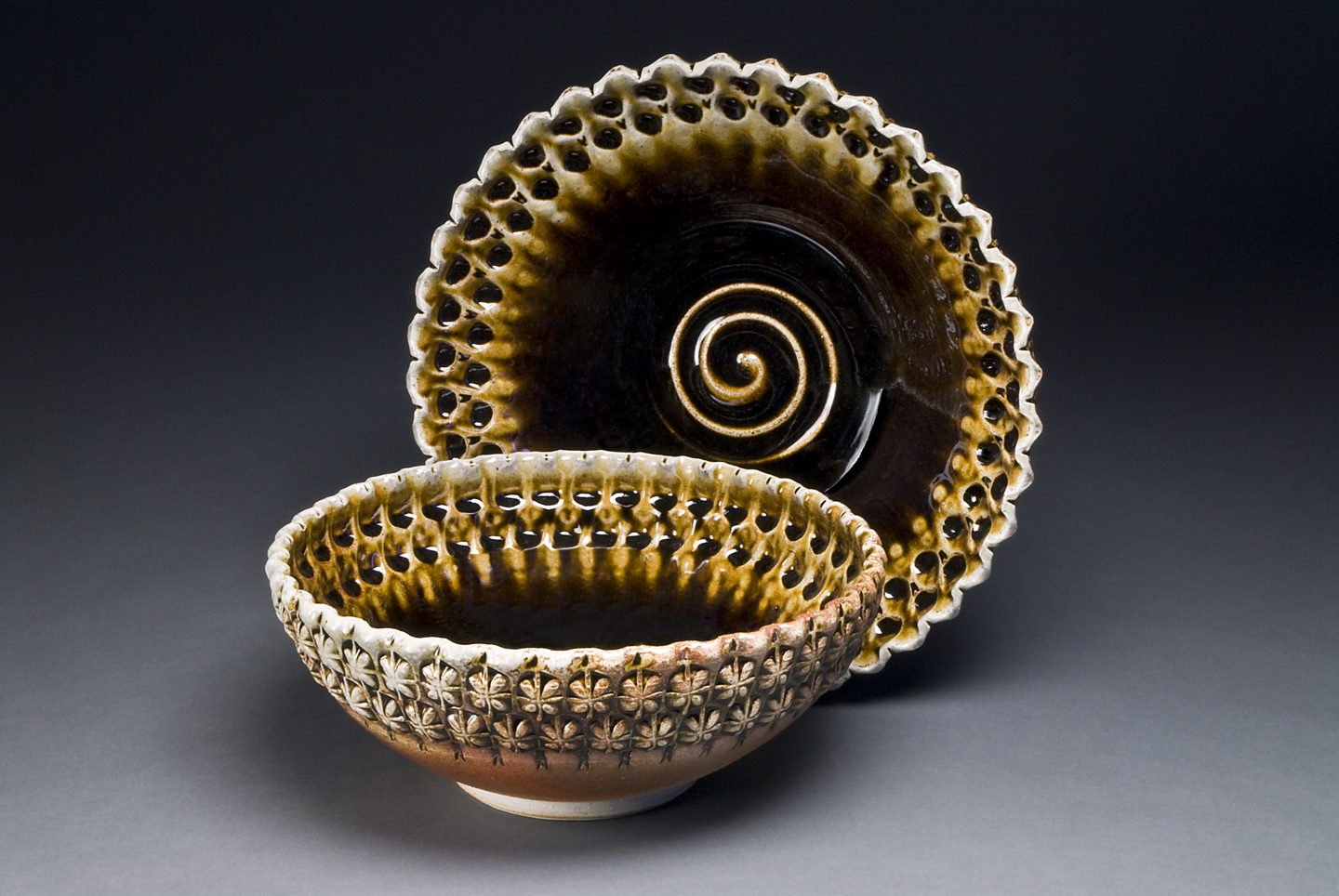
Untitled, porcelain tray, 2011, 10"x14"

Birdhouse, ceramic, 2011, 5"x 8"

Untitled, porcelain, 2011, 5" diameter

Untitled, ceramic, 2011, 5" square tiles

Thursday, September 22, 2011

Art21 series

Hi All, some of you in class didn't know about the Art21 series from OPB.  It is a show and resource website for art in the 21st century, i.e. contemporary art. We've seen some of the videos in classes here but you can see them all online too. Here are some links so you can check it out:

Daily news, features, and updates: http://blog.art21.org 
The PBS television series: http://www.pbs.org/art21 
Art21 educational materials & public programs: http://www.art21.org 
Watch more Art21 videos: YouTube | ArtBabble | PBS Video | PBS Mobile
Stay informed and join the conversation on Facebook and Twitter

Tuesday, September 20, 2011

Writing about class theories

            This week’s blog assignment is to share some thoughts on some of the theories we have been discussing. That would be modernism to post-modernism, appropriation as critique, or identity.  Since I just completed my reading on identity that is first on my mind.  I found it really hard to filter out the messages of hate in the discussions of diversity.  I really felt attacked and insulted by the endless references to whites having power and privilege over other races. I don’t agree that we universally fit that mold any more than I think people of different races fit a stereotype.  In my reading summary for the article Interrogating Whiteness I wrote:
This article very politely told me all the many ways in which I, a white person, have been demonized by other races of people, and how my ways of thinking are no good and should be changed. Even my doing nothing is a problem because in doing nothing bad to anyone I am insulting him or her with my neglect. I am not allowed to understand other races of people, because I am not them, and simply being human together is not sufficient to overcome the obvious evil and neglect I perpetrate with my privileged and powerful whiteness. My position of insult demonstrates I do not understand (am ignorant) and puts me squarely in the bottom of the gene pool so others may now be elevated by my lesser classification.  Hurrah! Now I can just reinvent myself to my own place of intelligence and treat others with no regard, because I clearly can’t be respectful or change my role. How easy was that? In the end, the article summarizes that the concept of race was created to develop a hierarchy of power and oppression and that it will continue to reinvent itself but never change from that political standpoint.  Since I can’t change other people I guess I am left to delude myself into thinking I can change me.
So how does this all relate to my artwork identity? Well, interestingly, my current artwork is influenced by my perception of myself in relation to society. I feel, like many people do, that I am a bit of an outsider – someone who does not fit the mold. I try to demonstrate that by creating patterns and/or repetitions and then inserting something different that breaks or interrupts the pattern. That is what I have always done – break societal patterns and reinvent myself into what I hope is a better person.  What do we notice, the pattern or the interruption? Or both? How do we weigh the importance of each? You can’t consider what you don’t notice.  But when you notice things and consider them, what do they mean to you?
I think we each interpret relationships based on our own experiences and assumptions so everyone looking at my artwork will think something unique.  There may be some commonalities, but if you don’t talk to anyone about my art then you won’t know what they are. So I hope when you look at art you will talk about it and examine both your commonalities and differences, with respect and an open mind, just like the ideal of interracial communication. Everyone wants to be understood and respected for who they are. It does no good to examine differences by pointing out perceived flaws and making disdainful accusations about what you don’t like. That generates hate. What works is opening your mind to hear what others think and then agreeing you are each unique. My motto is “Do as you will, as long as you harm none”.  It is okay not to like something, but how you communicate that is what can be hurtful.  Then, how do we agree? By agreeing to disagree. Acceptance of individuality is the answer. And interestingly, that is the course our text suggests people are taking as they enter the digital age, though the author implies it is computers that are motivating our individuality, and not us choosing individuality. Identity becomes the real answer to the freedom people seek.  Be who you are. If something is wrong, fix it by changing yourself.  If you can create positive change by working with others, do that too. As a link in the chain you must first be the strongest individual you can be. I believe today’s artists are pointing us to agreement and global acceptance of differences when they create art that generates a conversation about identity.
And another thing: identity relates back to appropriation as critique. When we appropriate and change someone else's art, we are trying to restate who they are and what they mean, as well as to identify our own agenda. In a way, it is an attempt to communicate through agreement again, because in using the same art we are basing our conversation on a common, original idea. We are using the same thing to generate a new conversation. We ask ourselves how we can change our identity through examining our commonalities and differences.

In examining identity in art further, I have also contemplated what it means to be a contemporary artist and tried to define it further. What does contemporary mean? Does it simply mean it is the art we do today? What category will future historians apply to our art? Will we be the unified Pre-Apocalyptic Individual Identity era of artists? (Versus the post-post-modern artists? Can we use "post" twice?)  Does this categorization help or hurt our art? Once the label is applied are we now segregated into an artistic "race" of people who all did one thing, individually but in unison?  How is that for an oxymoron! In categorizing our current style of individualism we become no longer individual.  That actually sounds right to me when I look at how art is developing today.  We have become a circular argument that has no definition, by its very definition.  :)  Okay, I didn't have enough coffee this morning...  Now I will go be different by myself again. 

Saturday, September 10, 2011

Draft Artist Statement

Today the assignment is to create a draft artist statement. I've done that with my upcoming senior thesis project in mind. Some of my past work has a different drift, so the pictures I've attached of my past ceramics work may not relate as well to this statement as what I will do in the next few months. None the less, enjoy.


As a ceramic artist, I shape the clay of the earth and thereby claim the power of the female deity who brings forth a good life of fulfillment, abundance, and wisdom.  My favorite art themes are related to pleasures with purposeful references to nature and the patterns of life. I enjoy the process of working with clay because it embodies nature and makes me feel I am a part of it. I am an idealist and choose to reflect on growth, spirit, and relationships by modeling shapes that reflect the patterns of society and the expectations of others and then to juxtapose them and make my own statement. Societies tend to create a group-think and impose repeating patterns of behavior. Patterns may not appear problematic at first, but as they multiply they take over my life, and I feel controlled by them. I like interrupting, emerging from, or displacing oppressive patterns to break free and create a new and personal focal point. 

My technique is to sculpt and hand-build my ceramic art pieces using rolled slabs, stacked coils, or pinched chunks of clay. I also like to use clay pressed into shapes through an extruding device (similar to making spaghetti) and then assembled into repeating patterns. I use a combination of dark and light colored stoneware for the majority of my pieces, but may occasionally use porcelain to create a piece that emphasizes a smooth texture or translucent effect. The dark and light clay colors highlight differences or changes to a pattern.  Finally I use glazes to decorate my work when I want to add color and importance to the shapes. 

Here is a stoneware pot I made with stamped and extruded forms (but no juxtaposition):

This little porcelain sculpture is my dog Clyde in his favorite position:

Thanks for looking today! 
Bonnie

Saturday, September 3, 2011

Hi Everyone, Here's My First Blog

Here goes, a test of my blog just for you. I'm thinking about lots of artists I've looked at over the last few months.  Since I'm going to do a Senior Project on ceramics, I think I'll try to post some ceramic artists here to help remind me and share with you who's who.

Yesterday I looked on a list of contemporary artists posted by the magazine Ceramics Today. One lady who had some great works was Ruth Duckworth. She is passed away now, but has some great articles about her, even from the New York Times. Here is one site I googled with an article: http://www.artknowledgenews.com/Ruth-duckworth.html. Here is Ruth's picture:


Like me, Ruth didn't start her ceramics career until she was older - for her that was in her 40's (you didn't really think I was going to date myself, did you?) :) But she has had an illustrious career with lots of great work. I especially am drawn to her wall hangings. Go ahead and google her - some great pictures. I didn't find a website for her specifically - she must have pre-dated web presences.  I hope to do some wall hangings in my work too.

Another artist I looked at was Vipoo Srivilasa. He has a website at www.vipoo.com.  I like his ceramic sculptures and the comical twists he puts on them. Vipoo is Thai and has lived extensively in Australia, taking cultural influences from each place in his work. Isn't diversity grand? I can't even imagine what those cultural influences are like. Sometimes I feel like life in the US is a vacuum I can't escape. I've never had the money or resources to travel, heck, I've never been west of Las Vegas. What would it be like to be in Bangkok or Melbourne doing art? Vipoo says:
"Most of my works reflect both Thai and Australian cultures which have greatly inspired me. I find it very hard to tell which is which now, since both cultures seem to merge nicely in me. The boundary [between both cultures] is sort of blurred and blend together.

"A good example of this," he said, "is in the Indigo Kingdom series [a 2009 solo exhibition at Anna Pappas Gallery, in Melbourne].

"In this series, I reinterpreted a Thai temple's plan to build an imaginative kingdom that also featured the contemporary human impacts on the Great Barrier Reef."

I looked at the work and thought I could see temple figures with barnacles for decorations on them.  Like many contemporary artists, Vipoo likes to do a series of items with a theme. I guess that is what we are supposed to do for senior project, too. I imagine doing a series of patterned surfaces with things breaking out of them. Can you guess the gist of my work? (Anybody reading this please post a note and say hi just so I have an idea you are out there.)

For a third artist to look at here (I looked at several online) I pick Swiss ceramic artist Aline Favre. I love her modern sculptural pieces which have black and white juxtapositions of shape and color.  I also want to do work which highlights the dichotomy of shapes and patterns. Aline says:
"In my work, I like creating dialogs. White, pure and delicate porcelain is confronted to other materials as raw and black stonewares, very "chamottés" (grogged [ed.]). Their specific languages allow me to play with and to fit them together into space. Oppositions are made of light and heavy, delicate and raw, white and black. Fire reveals their particularities mixing tightness, collapse, tearing. As life, with its succession of memories and emotions, I carry on the dialog". 
 A picture of her work:

The other thing this work does that I like is to use repeating forms and possibly extruded forms. Extruding in ceramics is pressing the clay through a cut-out mold like we do to make spaghetti or playdoh when we were kids.  I used to love playdoh. How about you? 

Okay, so now I'm off to do more homework. TTFN
Bonnie